





Golf GPS tech has come a long way in a few short years. The best golf GPS watches and devices now help you understand the hole before you tee off, avoid hazards you might not be able to see from where you are standing, and choose smarter targets before you swing.
But not all devices have the same features, and not all features are definitely going to be useful for you and your game. For one golfer, the perfect GPS is a lightweight watch that delivers front, middle and back distances in an instant. For another, it's a full-color course map showing the carry over every bunker and the depth of each green.
In this guide, we’re going to demystify the options and help you choose the best golf GPS watch or device for your game.
Already know what you are looking for? Explore our range of golf GPS watches and trackers here.
What Is a Golf GPS?
A golf GPS uses satellite positioning and course data to calculate where you are on the golf course and provide distances to useful points around the hole.
More advanced golf GPS devices may also provide:
-
Distances to bunkers, water and other hazards
-
Carry and lay-up yardages
-
Full-hole maps
-
Green shapes
-
Pin positioning
-
Touch targeting
-
Shot measurement
-
Digital scoring
-
Strokes-gained analysis
-
Elevation-adjusted distances
-
Club recommendations
The important word there is may! Not every GPS does everything, and, if we're being honest, not every golfer needs it to.
That means the best golf GPS is not automatically the device with the longest list of features. It’s the one that gives you useful information quickly enough to influence the shot you are about to hit.

Which Golf GPS Is Best for You? A Quick Guide
Before we disappear down a rabbit hole of specifications, let’s start with how you actually play.
Choose a straightforward golf GPS watch if...
You mainly want quick distances to greens and hazards without reaching for your phone or pulling another device out of the bag.
This is the simplest route into golf GPS and will be enough for plenty of golfers.
Choose a high-spec GPS watch if...
You want to see more of the hole from your wrist, including hazards, green shapes and potential landing areas.
This is particularly useful if you regularly play unfamiliar courses or want to think more carefully about shot and club selection.
Choose a premium golf smartwatch if...
You want advanced golf features but also expect to wear the watch away from the course.
This is where Garmin's broader approach becomes particularly relevant, with models designed to combine golf functionality with everyday smartwatch and activity features.
Choose a handheld golf GPS if...
You want a larger screen and more room to study the hole.
Handheld devices can be excellent for golfers who prioritise detailed visual mapping or simply do not like swinging with a watch on their wrist.
You can compare the latest golf GPS watches and handheld devices right here.
Golf GPS Watch vs Handheld GPS: Which Is Better?
For most golfers, this is the logical place to start.
Both formats can provide excellent course information. The difference is how you want to access it.
Why choose a golf GPS watch?
Convenience is the big advantage here.
A golf GPS watch stays on your wrist throughout the round. When you reach your ball, the information you need is already there, so you can quickly check the distance, choose the club, and hit your shot.
A GPS golf watch is particularly useful if you want:
-
Fast access to yardages
-
A device that is difficult to leave in the golf bag
-
Minimal disruption between shots
-
Course information while walking
-
Golf and everyday watch features in one device
The compromise is the screen size. Even a chunky GPS watch will have a smaller display than a dedicated handheld device.

Why choose a handheld golf GPS?
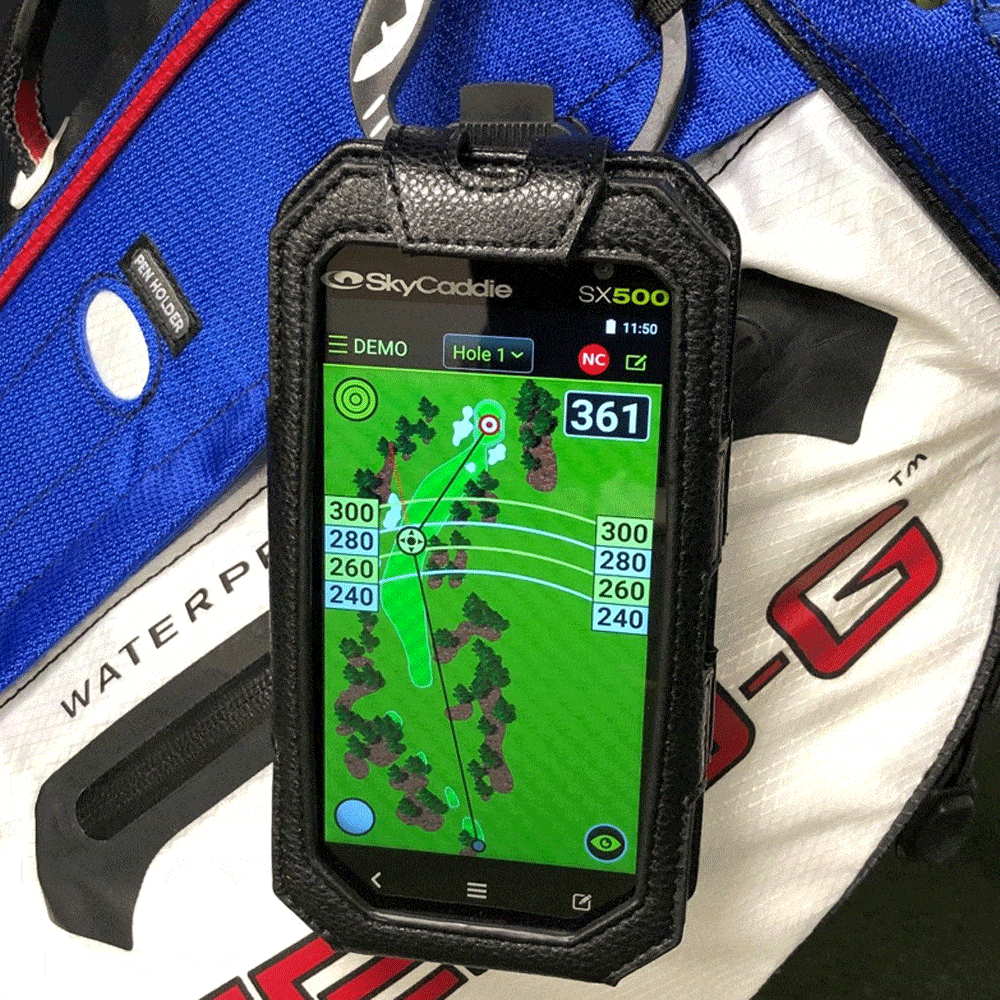
A handheld GPS gives you more screen space, which can make it easier to understand the shape of a hole, study hazards and work out the best route from tee to green.
On a course you know well, you may not need that much information. But on a course you've never played before, knowing that the fairway disappears behind a dogleg, the green is 35 yards deep, and that innocent-looking bunker is exactly where your driver tends to finish up suddenly becomes rather useful.
A handheld golf GPS makes particular sense if you:
-
Prefer a larger display
-
Want detailed visual course maps
-
Regularly play unfamiliar courses
-
Do not enjoy wearing a watch while playing
-
Put a high value on course management
The obvious compromise is accessibility.
A watch is already on your wrist, while a handheld device is only convenient if you remember which of the 23 pockets in your golf bag you put it in.
Garmin vs SkyCaddie: Which Golf GPS Is Right for You?
Garmin and SkyCaddie are two of the biggest names you’re going to come across when shopping for a golf GPS.
Both can put useful course information at your fingertips, but the buying decision is about more than comparing specification sheets.
The better question is what role you want your GPS to play.
Why Choose a SkyCaddie GPS?
SkyCaddie is ideal for golfers who want to put course mapping at the heart of their decision-making.
Products such as the SkyCaddie LX5 and SkyCaddie LX5C send detailed course information directly to your wrist, which matters when the challenge you have is more complicated than how far away the green is. If you want to know how much green is behind the flag, or where you should actually be aiming, these devices provide that level of insight and more.
For golfers who want more screen space, a handheld SkyCaddie device such as the PRO 5X lets you study the course on a larger display.
A SkyCaddie GPS is worth considering if:
-
Golf is the main reason you are buying the device
-
Course mapping matters to you
-
You regularly play at unfamiliar courses
-
You value detailed visual information
-
You want a choice between a watch and handheld formats
Explore the available SkyCaddie and other golf GPS devices in our GPS collection here.

Why Choose a Garmin Golf GPS Watch?
Garmin takes a slightly different route.
Its Approach range is popular with golfers who want golf functionality but also want additional, more conventional smartwatch features.
The Garmin Approach S44 and Approach S50 focus on delivering useful golf GPS functionality with a wider mix of everyday activity and smartwatch functions. The Approach S44 focuses primarily on core golf GPS features, while the Approach S50 adds broader health and fitness functionality.
At the premium end, the Garmin Approach S70 is aimed at golfers looking for a more advanced golf smartwatch, with greater emphasis on course information and on-course decisions.
A Garmin golf watch is likely to appeal if:
-
You want GPS information on your wrist
-
You want a device that can be useful away from the golf course
-
You value having access to broader smartwatch functions
-
You want different levels of functionality depending on your budget and priorities
-
You prefer a watch over a dedicated handheld GPS
For the golfer who plays on Saturday, goes for a run on Sunday and wants the same device on their wrist on Monday, that wider functionality can make plenty of sense.
Garmin Approach S44 vs S50 vs S70: How Should You Choose?

The easiest way to compare Garmin golf watches is not to ask which is objectively best. Instead, start with what you want the watch to do. The S44 and S50 both have AMOLED displays, preloaded course mapping and core golf functionality, but the S50 adds wrist-based heart rate and substantially broader health, wellness and activity features. The S70 then moves further into premium golf functionality, including advanced PlaysLike calculations, detailed CourseView mapping and Virtual Caddie features.
Garmin Approach S44
The Garmin Approach S44 is the one to consider when your priority is straightforward access to useful golf information.
You want course distances on your wrist, you want to check them quickly, and you don't really need a golf watch to become the command centre for the rest of your life.
For golfers who mainly want GPS support during the round, the simplicity offered by the Garmin Approach S44 can be a strength rather than a compromise.
Garmin Approach S50
The Garmin Approach S50 makes more sense when you expect to wear your golf watch around beyond the course.
It's great for golfers who want GPS functionality during a round but also value broader activity tracking and everyday watch features.
If you only take the watch out of your bag five minutes before your tee time, paying more for features designed for the other six days of the week becomes harder to justify.
Garmin Approach S70
The Garmin Approach S70 sits at the more advanced end of the spectrum.
This is for the golfer who wants more than basic distances and sees the watch as part course-management tool, part premium smartwatch.
That makes it the natural choice for serious golfers who expect to use advanced on-course features regularly and also want a device that fits into everyday life.

SkyCaddie LX5 vs LX5C vs PRO 5X: Which Format Makes Sense?
Choosing between SkyCaddie devices starts with a slightly different question: Do you want the information on your wrist or in your hand?
SkyCaddie LX5
The SkyCaddie LX5 is the obvious starting point if you like the idea of detailed golf GPS information but want the convenience of a watch.
It's there when you reach the ball, requires minimal interruption to your routine and avoids adding another device to the collection already rattling around your golf bag.
For golfers who want course information quickly and consistently throughout the round, wrist-based GPS is hard to beat.
SkyCaddie LX5C
The SkyCaddie LX5C takes a similar approach but is positioned as the more premium option.
This makes the decision less about choosing an entirely different type of GPS and more about how much you value the finish and feel of the device itself.
If a watch is going to spend several hours at a time on your wrist, those details are not completely superficial.
SkyCaddie PRO 5X
The SkyCaddie PRO 5X is for golfers who would rather have a larger device in their hand.
The advantage is obvious when you want to study the hole in more detail. The bigger screen gives your map more room to be useful, particularly when playing somewhere new.
The downside for some will be that you need to pick it up and study it.
For some golfers, that is no inconvenience at all. For others, anything not physically attached to them has a good chance of being left in the clubhouse.
How Much Course Information Do You Actually Need?
For plenty of golfers, front, middle and back distances provide most of the information needed to make a sensible club choice.
Imagine the middle of the green is 150 yards away. The front is 137. The back is 166. There are things to avoid short of all that. That tells you far more than one isolated number to the flag.
When you know how deep the green is, the penalty for coming up short, and how much room you have beyond the pin, you can make a more calculated decision on club choice and approach.
More detailed GPS mapping becomes useful when you regularly need to answer questions such as:
-
How far is it to carry the fairway bunker?
-
Where does the water actually begin?
-
Can my driver reach the trouble?
-
What distance leaves the widest part of the fairway?
-
How deep is the green?
-
Where is the safest miss?
-
What is hidden around the corner?
This is the difference between using GPS purely for distance and using it for course management.
The best golf GPS devices help you make a better decision before you worry about executing it.
What Should You Look for in a Golf GPS Watch?
Once you have chosen the general type of device, there are a few things worth examining properly.
Display Quality
Your GPS will be used outside. Sometimes in bright sunshine, sometimes in rain, and sometimes while three people stand on the fairway behind you wondering whether you intend to hit the ball this week.
Long story short, the display needs to be easy to read and quick to understand.
Consider the screen size, brightness, resolution, map detail and touchscreen responsiveness.

Controls
Touchscreens are useful when you want to interact with maps, move targets or explore different parts of the hole.
Physical buttons can be easier when conditions are wet or you simply prefer something more tactile.
Neither approach is automatically better, but what matters is how quickly you can get to the information you need.
Comfort and Watch Size
Some golfers barely notice a watch while swinging.
Others put one on and immediately become convinced it has changed their entire takeaway. So sure, larger screens give maps more room and make them easier to read, but they also mean a more bulky watch on your wrist.
Battery Life
Always look at battery life in GPS mode.
Normal smartwatch battery figures tell you very little about how long the device will last when it is actively tracking your position around a golf course.
For most golfers, comfortably completing 18 holes should be the minimum expectation.
You may need more if you:
-
Regularly play 36 holes
-
Take golf trips
-
Play several rounds between charges
-
Frequently forget to charge every electronic device you own
Golf Features vs Everyday Smartwatch Features
This is one of the biggest dividing lines in the premium golf watch market. Some devices are primarily golf tools, while others are smartwatches that happen to be very good at golf.
Neither is inherently better, but it makes sense to go with a broader smartwatch if you want to use the device for:
-
Everyday activity
-
Fitness
-
Exercise
-
General health tracking
-
Notifications
-
Other sports
This is one reason Garmin golf watches are so popular.

Golf GPS Watch FAQs
What is the best golf GPS watch?
The best golf GPS watch depends on what you actually want it to do.
If you mainly want quick distances to the front, middle and back of the green, a simpler GPS watch may be all you need. If you regularly play unfamiliar courses or want more help with course management, look for a model with detailed hole maps, hazard information and a larger colour display.
Golfers who plan to wear their watch away from the course may get better value from a golf smartwatch that combines GPS functionality with fitness, activity and everyday features.
The best choice is not necessarily the watch with the longest specification list. It is the one that gives you useful information without making every shot feel like a software demonstration.
Which golf GPS should I buy?
Start with the problem you want the device to solve.
Choose a basic golf GPS watch if you want fast yardages and minimal fuss.
Choose a detailed mapping watch if you want to see hazards, green shapes and the wider layout of the hole.
Choose a golf smartwatch if you want a device that works both on and off the course.
Choose a performance tracker if you want your rounds to generate useful data about club distances, scoring patterns and where you are gaining or losing shots.
Choose a handheld golf GPS if you prefer a larger screen or do not like playing with a watch on your wrist.
Is Garmin or SkyCaddie better for golf?
It depends on your priorities.
SkyCaddie is particularly appealing to golfers who place a high value on detailed course mapping and want a golf-first GPS experience, with both watch and handheld options available.
Garmin is a strong choice for golfers who want dedicated golf functionality alongside the broader benefits of an everyday smartwatch ecosystem.
Neither is automatically better. Think about whether you primarily want a dedicated course-management tool or a watch that will also earn its place on your wrist away from the golf course.
Which Garmin golf watch should I buy?
The Garmin Approach range serves different types of golfer.
The Garmin Approach S44 is the more straightforward option for golfers primarily interested in GPS golf functionality.
The Garmin Approach S50 makes more sense if you want golf features combined with broader fitness, activity and everyday watch functionality.
The Garmin Approach S70 sits at the premium end of the range for golfers who want a more advanced golf smartwatch and expect to make regular use of its additional on-course features.
Do not automatically buy the most expensive model. If you only need clear yardages during your weekly round, paying for features designed for the other six days may not represent better value.
What is the difference between the SkyCaddie LX5 and LX5C?
The SkyCaddie LX5 and LX5C are both wrist-based golf GPS devices aimed at golfers who want detailed course information without carrying a separate handheld.
The LX5C offers a more premium ceramic bezel, so the decision is largely about the finish and design you prefer rather than choosing between two completely different types of GPS.
Golfers who prefer studying course maps on a larger screen may be better suited to a handheld device such as the SkyCaddie PRO 5X.
Do golf GPS watches require a subscription?
Some do, while others include their main features without an ongoing fee. There are also devices where the core GPS functionality is included but certain mapping, updates or premium features require a membership.
SkyCaddie uses a membership-led course-mapping ecosystem. Basic front, middle and back distances may be available through its free plan, while fuller mapping, broader course coverage and connected services require a paid membership. Garmin includes core course functionality with the watch, while some enhanced mapping and analysis features may require a Garmin Golf membership.
The cheapest purchase price is not always the cheapest way to own and use a device over several years. Equally, avoiding a subscription for the sake of it makes little sense if the alternative does not provide the features you actually want.
Compare what is included from day one, what requires an ongoing payment and which of those features you will genuinely use.
Are expensive golf GPS watches worth the money?
They can be, but only when you will use what you are paying for.
Premium golf GPS watches tend to justify the extra cost in three areas: better displays and mapping, more advanced golf features, and broader smartwatch functionality away from the course.
A larger, brighter screen can make a genuine difference if you regularly study hole layouts and hazards. Advanced course-management features may appeal to serious golfers who want more context than a simple yardage. And a premium smartwatch becomes easier to justify when you wear it every day rather than twice a month.
If all you want is front, middle and back distances, however, there is nothing wrong with buying a device that does that job well.
Can a golf GPS watch give me the exact distance to the flag?
Not necessarily.
Golf GPS watches commonly provide distances to mapped points such as the front, middle and back of the green. A laser rangefinder measures the specific visible target you aim at, usually the flag.
Some advanced GPS devices allow you to adjust the pin position or select different points on the green, but that is still different from directly measuring the flag with a laser.
Why does my golf GPS show a different distance from my laser rangefinder?
Because they are probably measuring different targets.
Your laser may show the exact distance to a flag positioned near the front of the green. Your GPS may be displaying the distance to the centre.
Those numbers should be different, and that's why the two technologies work well together. The GPS gives you the wider context of the hole and green, while the laser provides a precise distance to a visible target.
Is a golf GPS worth buying if I already own a rangefinder?
Yes, particularly if you want more information about the hole than one precise distance.
A laser rangefinder is excellent for measuring visible targets. A golf GPS can show distances to the front and back of the green, bunkers, water, lay-up points and hazards that may be hidden from view.
Many golfers therefore use GPS for course management and a laser to confirm the exact flag distance.
One tells you how far the pin is. The other can help you decide whether attacking it is actually a good idea.
Does a golf GPS watch work without a phone?
Many dedicated golf GPS watches can provide their core course distances without an active phone connection while you play.
A smartphone may still be needed for setup, software updates, syncing scores or performance data, and accessing certain connected features.
Check the requirements of the individual device if playing without your phone is important to you.
How accurate are golf GPS watches?
A good golf GPS watch should provide dependable distances to mapped course features, although small variations can occur because of satellite positioning, your exact location and the way the course has been mapped.
It is also important to compare like with like. A GPS distance to the middle of the green is not supposed to match a laser measurement to a flag sitting ten yards from the front.
For most golfers, GPS accuracy is more than sufficient for making sensible club and course-management decisions.
Will a golf GPS work on every golf course?
Course coverage varies between GPS providers, so it is worth checking before you buy if you regularly play a particular venue.
This is especially relevant for newly opened courses, recently redesigned layouts and smaller venues.
Do not get too distracted by the biggest headline number of mapped courses. What matters is whether the courses you actually play are covered accurately and kept up to date.
How much battery life does a golf GPS watch need?
Look specifically at the manufacturer's battery estimate in GPS or golf mode rather than the standard watch-mode figure.
For most golfers, comfortably getting through 18 holes is the minimum. If you regularly play 36 holes, take golf trips or want to play several rounds between charges, you will need considerably more headroom.
It is also worth considering your own charging habits. A watch capable of lasting several rounds is particularly useful if every electronic device you own is routinely sitting at 12%.
Can I use a golf GPS watch in a tournament?
The Rules of Golf generally allow distance-measuring devices. However, a committee can prohibit them through a Local Rule, and golfers cannot use features that measure elevation changes or interpret distance and directional information to recommend a club or line of play.
Check the competition rules before teeing off and make sure the device is set up appropriately.
Are larger golf GPS watches better?
Not automatically. A larger display gives course maps, hazards and green information more room, which can make detailed GPS features easier to use.
The trade-off is that a larger watch may feel heavier or more noticeable during the swing.
If you mainly want quick yardages, a compact watch may be the better option. If detailed visual mapping is important to you, the extra screen space can be worth having.
Choose the size based on how you intend to use the GPS, not simply on which model has the biggest screen.